061023 Learn about Obesity[1]
My thanks to the Obesity Action Coalition (OAC) educators for the following important information.
Obesity is a serious and rising health epidemic in our country. You are not alone in this fight. It is estimated that nearly 93 million Americans are affected by obesity and that number is predicted to climb to 120 million within the next five years.
There are various classifications of obesity. You may have heard various terms such as “severe obesity” or also “childhood obesity,” readily used by physicians and the public. This section will help you gain a better understanding of obesity, severe obesity, how to measure your weight and much more.
What is Obesity?
Obesity is a treatable disease and a worldwide health concern associated with having an excess amount of body fat. It is caused by a combination of genetic and environmental factors and can be challenging to manage through dieting alone.
Healthcare providers often diagnose obesity based on a person’s body mass index (BMI), which is considered to be 30 or greater. It’s important to note that nearly 40 percent of Americans are affected by obesity.
Obesity Is:
- A disease
- A worldwide health concern
- Caused by many factors
- Treatable and manageable
Obesity Is Not:
- Your fault
- Yours to manage alone
- Just about food
- Cured by a miracle treatment
Body Mass Index (BMI)
Diagnosing obesity and measuring body fat directly can be challenging, which is why body mass index (BMI) is often relied upon for insights. BMI measures the relationship between height and weight. It is essential to note that measuring BMI does not replace clinical judgment. To calculate BMI, one needs to divide their weight in kilograms by their height in meters squared, following the formula BMI = kg/m2.
To determine your BMI, please see the BMI chart provided here.
https://www.obesityaction.org/education-support/learn-about-obesity/measuring-my-weight/
Despite its widespread use in the healthcare community, BMI has its limitations. It does not directly measure body fat and fails to account for factors like muscle mass, bone mass or fat distribution. Additionally, the validity of some of the existing BMI cutoffs have been questioned, as they were not developed using diverse populations. Social determinants, race, ethnicity and age may influence the risk associated with a particular BMI.
BMI is just one component of diagnosing obesity. It is important to consult with your healthcare provider to explore other methods of determining obesity.
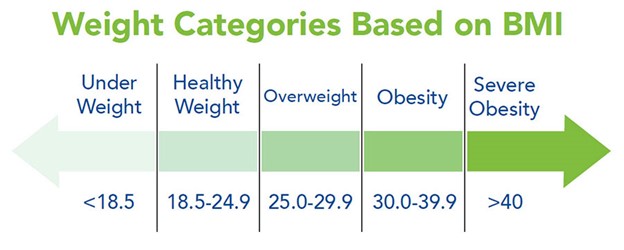
How Weight is Categorized
Overweight
Having a BMI in the overweight range (25.0 29.9) is a health concern. Excess weight is hard on your body. It can lead to other health problems including obesity. People who have a BMI in the overweight range and have other health problems (such as type 2 diabetes or heart disease) need to see their healthcare provider for treatment options.
Obesity
Obesity is a disease where a person’s weight is in an unhealthy range (BMI of 30.0-39.9). It is a disease that can lead to other health problems. Talk with your healthcare provider to better understand and treat obesity.
Severe Obesity
Someone who is more than 100 pounds over their healthy body weight (BMI greater than 40) has severe obesity. Severe obesity has the greatest risk of other health problems. People with severe obesity need to see their healthcare provider for treatment options.
[1] https://www.obesityaction.org/education-support/learn-about-obesity/
 Physically Fit Seniors